Amelia Dale interviews Corey Wakeling
‘Borders have very little to do with physical boundaries and far more to do with ideational ones. For me, the practice of political thought is very much about understanding ideological coding, about learning how we are constructed as subjects.’
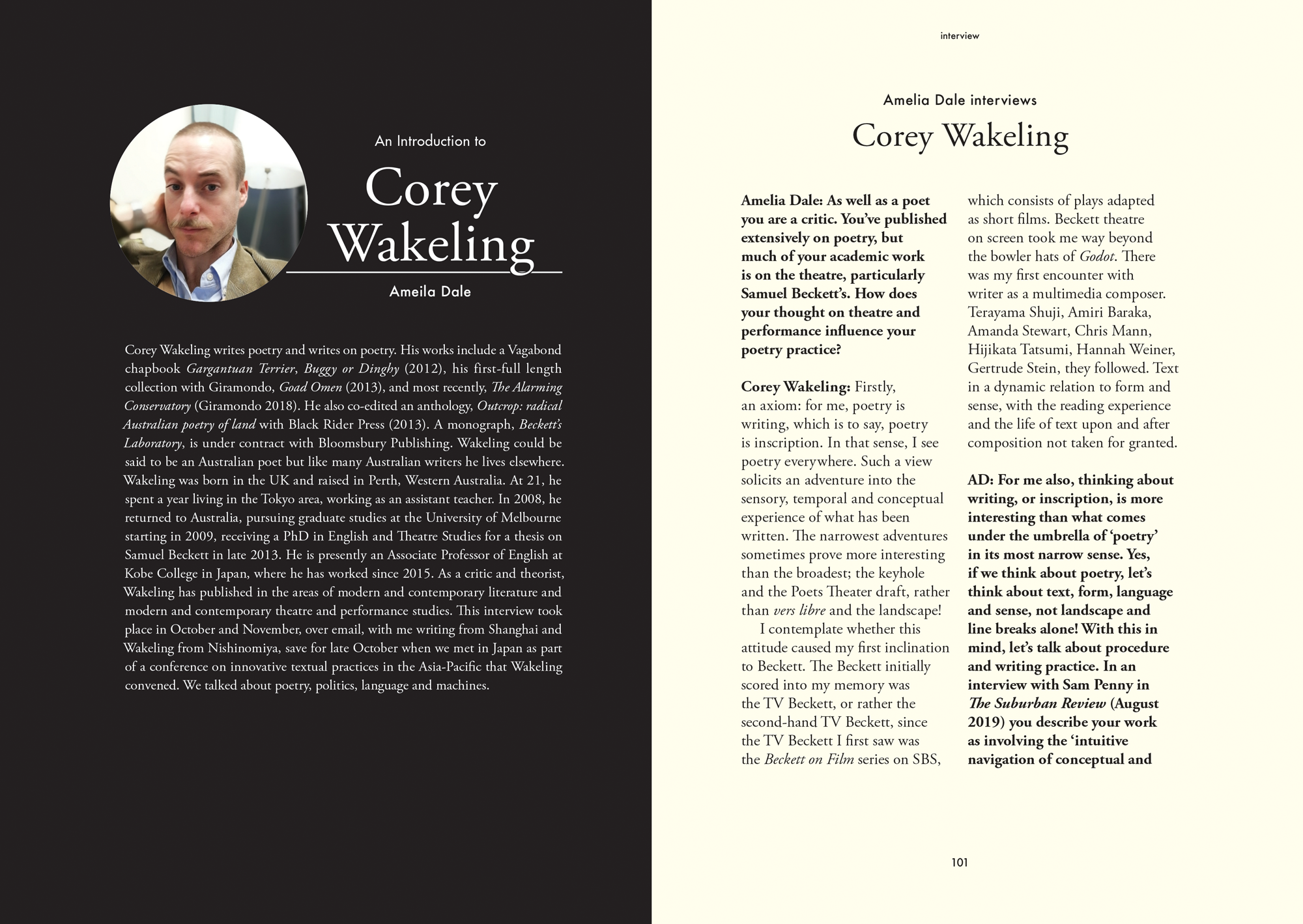
Corey Wakeling was born in the UK and raised in Perth, Western Australia. At twenty-one, he spent a year living in the Tokyo area, working as an assistant teacher. In 2008, he returned to Australia, pursuing graduate studies at the University of Melbourne starting in 2009, receiving a PhD in English and Theatre Studies for a thesis on Samuel Beckett in late 2013. During his years in Melbourne, Corey published two collections, a Vagabond chapbook Gargantuan Terrier, Buggy or Dinghy (2012) and his first-full length collection with Giramondo, Goad Omen (2013), and co-edited an anthology, Outcrop: radical Australian poetry of land with Black Rider Press, also in 2013. His most recent collection of poems is The Alarming Conservatory (Giramondo 2018). He is presently an Associate Professor of English at Kobe College in Japan, where he has worked since 2015. As a critic and theorist, Corey has published in the areas of modern and contemporary literature and modern and contemporary theatre and performance studies. His monograph, Beckett’s Laboratory, is under contract with Bloomsbury Publishing.
Amelia Dale is a retired poet and the Interviews Editor of Rabbit.

When Matthew Hall and Chi Tran—our guest poetry editors for this issue—proposed the theme of ‘Lineages’, I started to think of poetry inheritance, a poetry family tree, what my own might look like.
I thought of the poets I studied (or was made to study) in high school and who made me reluctant to continue reading poetry. I thought of the poets introduced to me by mentors who understood my tastes, the poetry that opened up possibilities for my reading and writing future. I thought of the poets whose work stretched my own lines, whom I have followed so closely that I feel their words and rhythms in my blood and bones. It is rare that we come across that last category. For me, there are two poets whose work I hold close—one American, one Australian. For those of you who have been reading my editorials for the last few years, you can probably guess who they are. Not only responsible for fuelling my curiosity and experimentation, these poets have also had the effect of giving me permission to find my own voice in and through poetry. Whether they like it or not, I consider them to be kin.
One of the great pleasures for me as managing editor of Rabbit has been to read the responses of contributors to the ‘Rabbit question’ for each issue, which is linked to the issue theme. When this requirement was set up from issue one, it was intended to encourage all those who submitted poems to demonstrate their appreciation for poetry more broadly, ahead of the desire to send through poems quickly in the hope of getting published. But the responses from those who are selected for publication, printed in the back pages of each Rabbit, are also a way to share poetry knowledge to readers, to suggest poets or poems that may not have been known to some readers, to share tastes and reading lists. I like to see that some contributors are able to sum up their thoughts in very few words—sometimes just one!—while others commit to a generous rumination.
The question for this ‘Lineages’ issue is: What is something you have learned from a poem/poet that you’d like to pass on to others? From the thoughtful answers printed at the back, I can see that many poets have located their own poetry kin, as I have done. More than this, it seems that they have drawn strength from that kin not only to guide their own writing practice but also to guide the living of a good life. How marvellous!